NyayaSetu
Offline-First AI Governance Platform for Rural India

Overview
NyayaSetu (न्यायसेतु — "Bridge to Justice") is a production-grade, multilingual AI governance platform designed for rural Indian citizens and government officers with limited or no internet connectivity. It provides voice-native, Hindi/English/Hinglish access to government schemes, grievance routing, and notice management through local LLM inference — no cloud dependency required.
Links
The Problem
Over 833 million rural Indians lack reliable internet access, yet the delivery of government welfare schemes, grievance redressal, and public notices has moved almost entirely online. Approximately 313 million adults in India cannot read or write, making text-only digital portals effectively inaccessible. Fewer than 30% of eligible beneficiaries successfully access entitlements they qualify for, due to language barriers, connectivity gaps, and complex bureaucratic interfaces.
The Solution
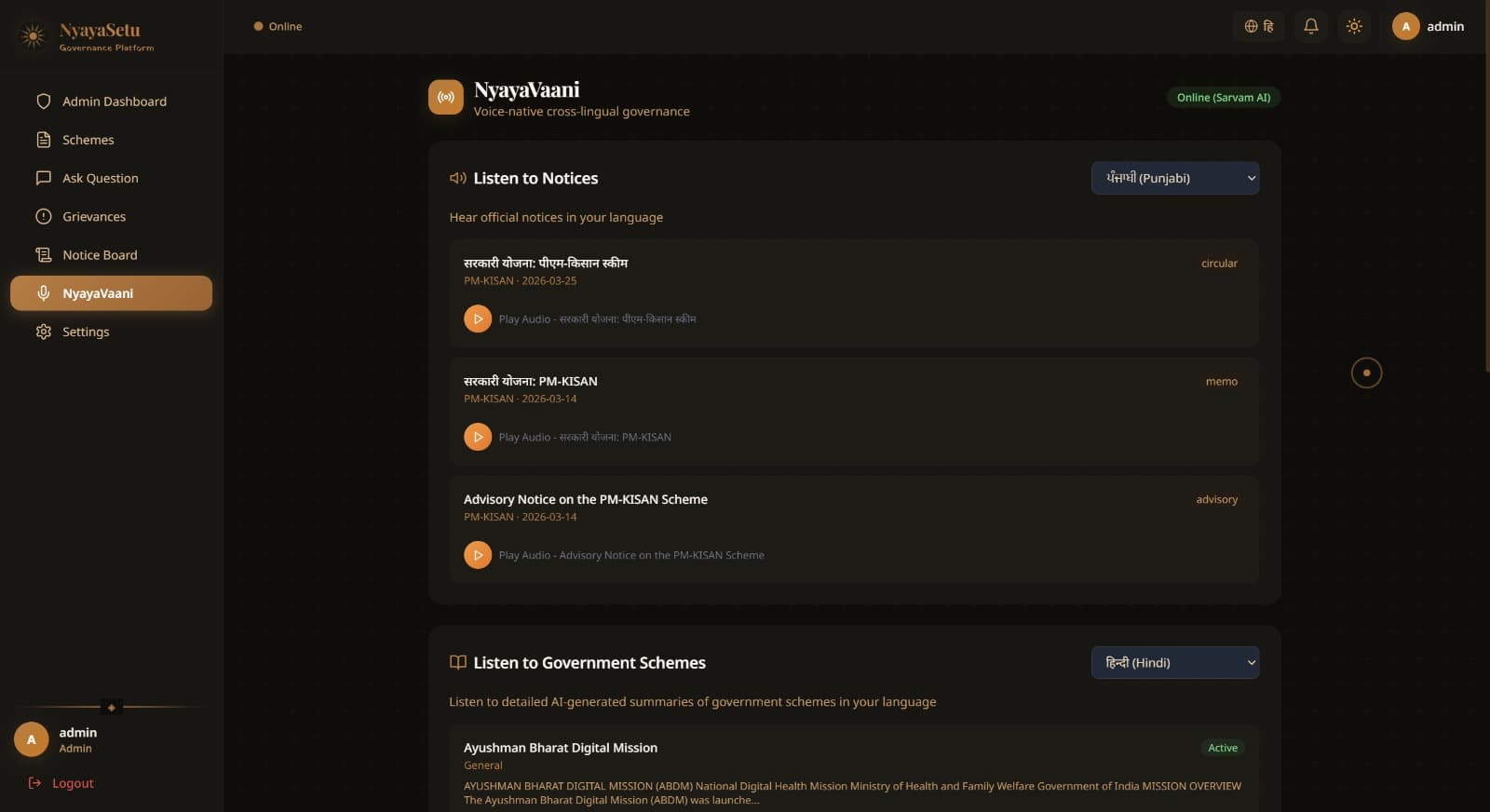
NyayaSetu deploys entirely on-device using Ollama-managed local LLMs (Qwen2.5-14B for structured reasoning, Sarvam-optimized models for Indic language understanding), a FAISS vector store for semantic scheme search, and Helsinki-NLP multilingual embeddings — all without requiring internet. Citizens interact via voice in Hindi, English, or Hinglish; NyayaVaani transcribes speech with faster-whisper, routes queries through a RAG pipeline, generates contextual answers, and responds via Coqui TTS — completing the full loop offline.
Project Walkthrough
Agent Architecture
NyayaVaani — Voice Intelligence Engine
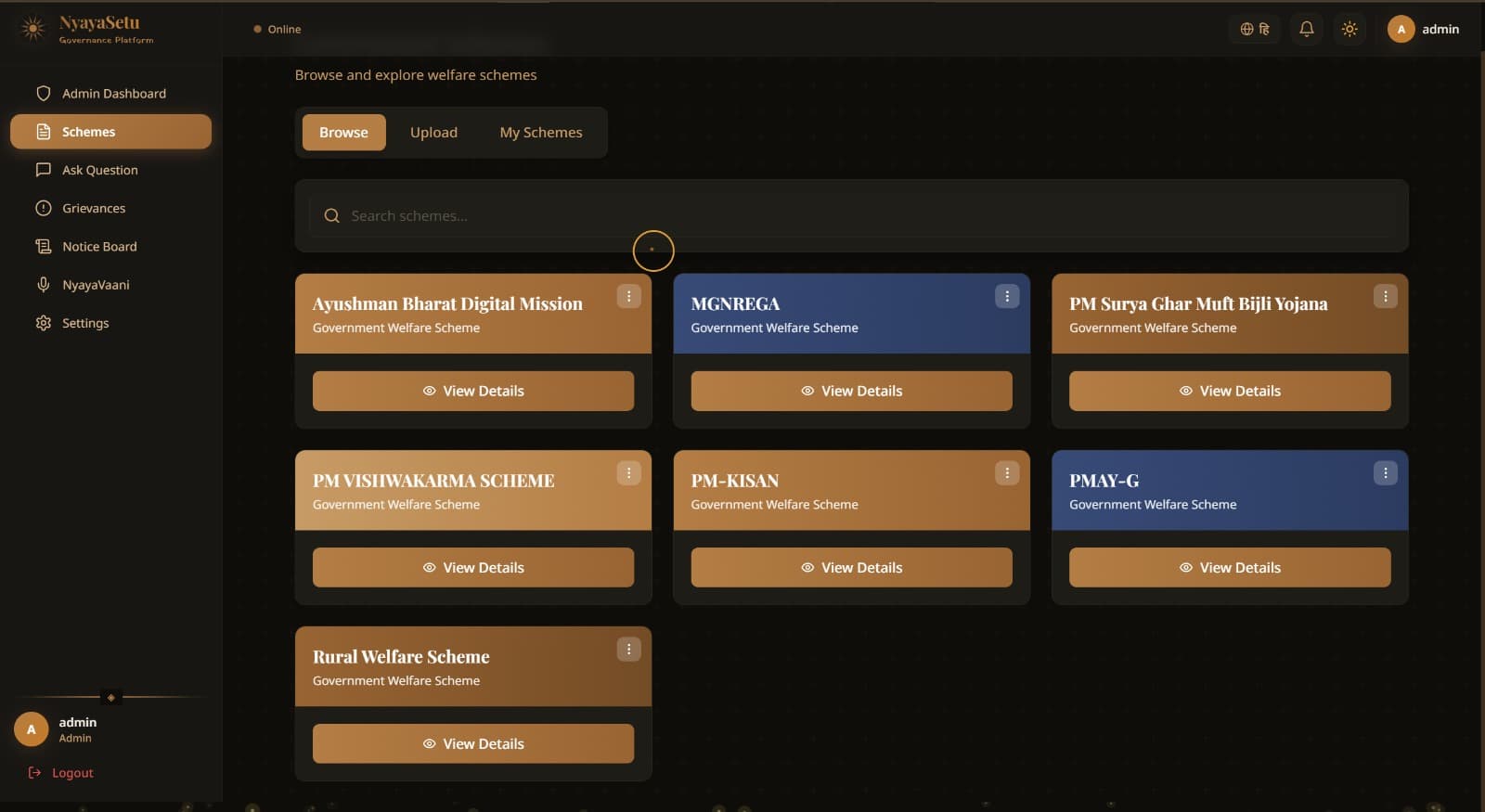
RAG Scheme Intelligence Engine
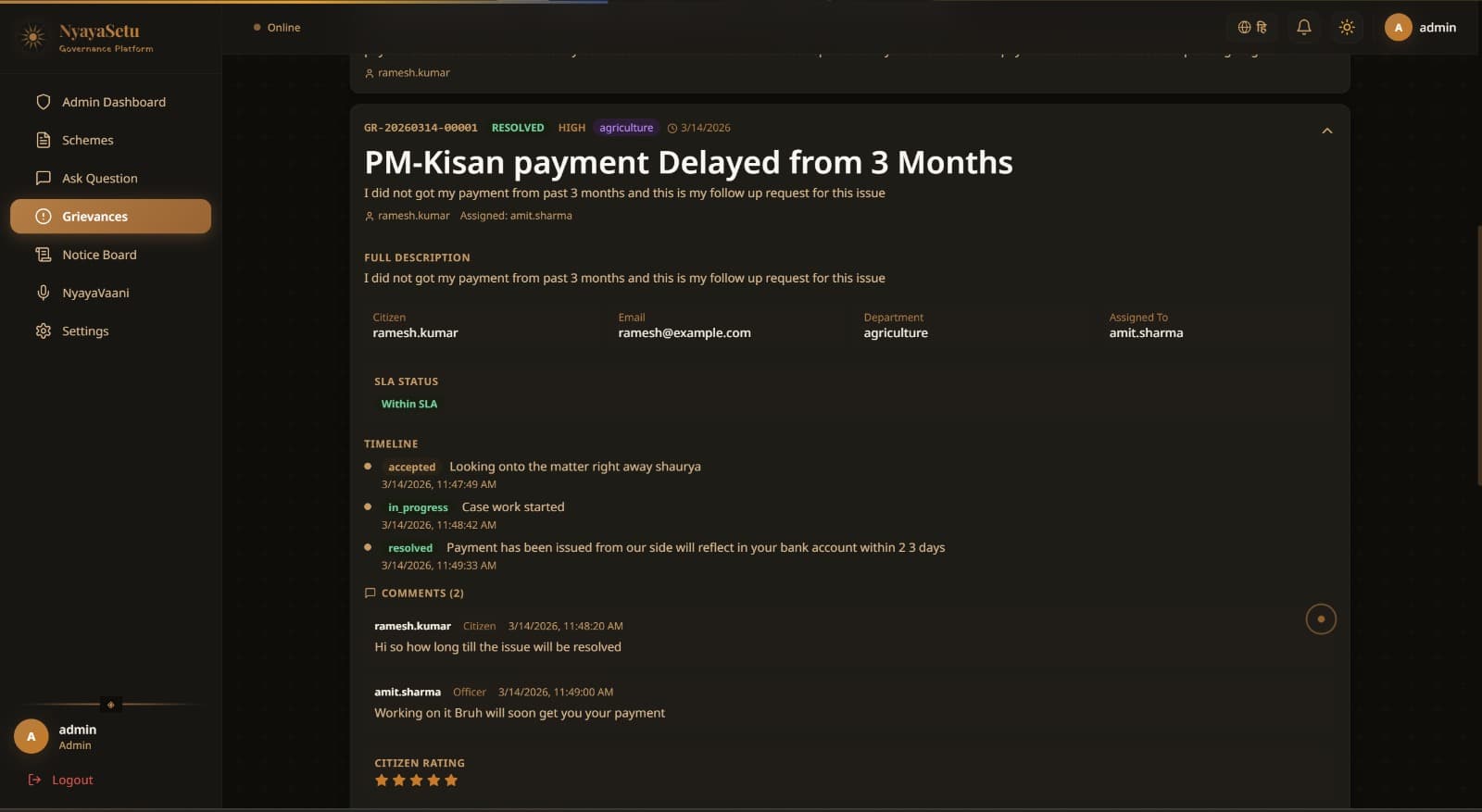
Grievance Router
Scheme Summarizer
Notice Drafter
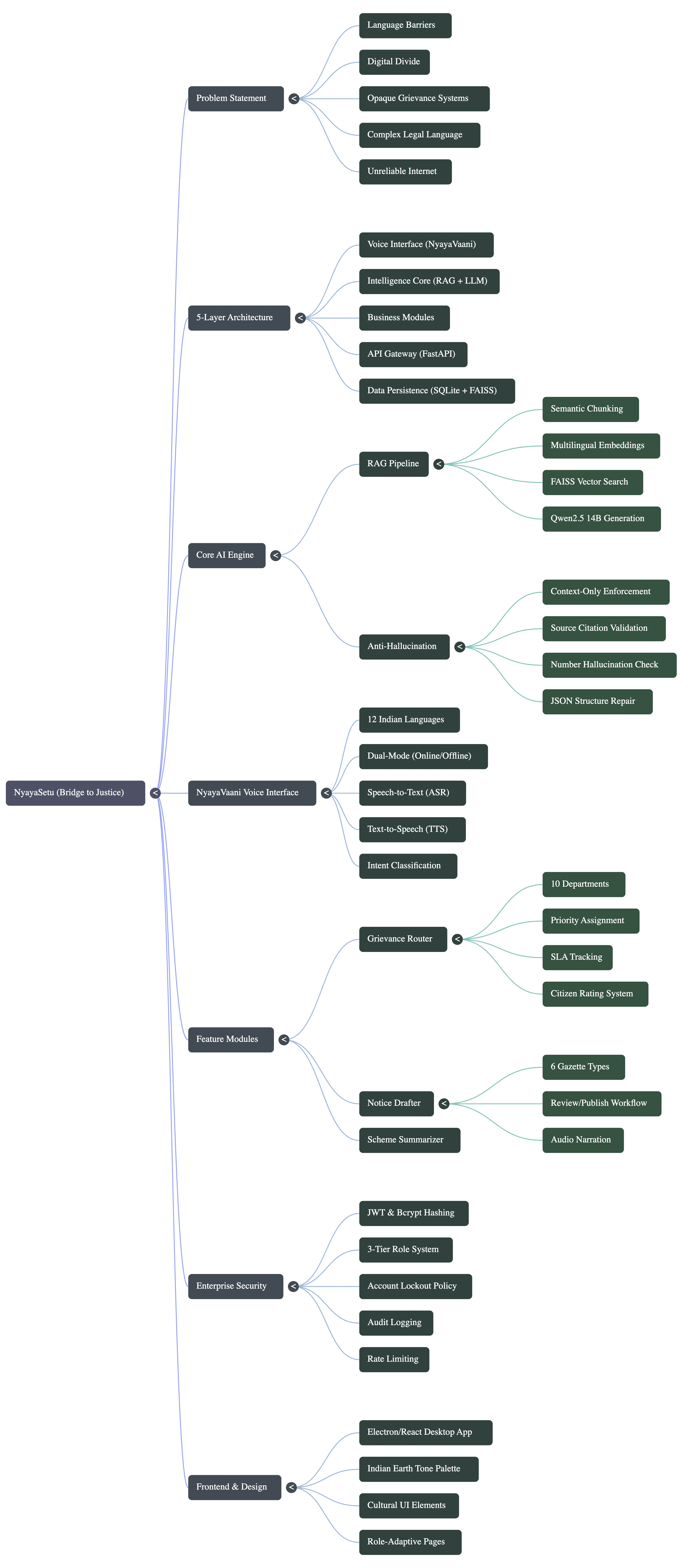
System Architecture
Technology Stack
client
- React 18
- TypeScript
- Electron (Desktop)
- HashRouter (Offline SPA)
server
- FastAPI (Python)
- SQLite (Offline-First)
- REST API + OpenAPI Docs
ai
- Ollama (Local LLM Runtime)
- Qwen2.5-14B
- Sarvam 24B (Indic Intelligence)
- faster-whisper (Offline ASR)
- Coqui TTS (Offline Synthesis)
- FAISS Vector Search
data
- SQLite (All Persistence)
- FAISS Vector Index
- Government Scheme PDFs
- In-Memory Cache (280x Speedup)
Key Features
Fully offline — all LLM inference runs locally via Ollama, zero cloud dependency
Voice-native multilingual interface: Hindi, English & Hinglish supported
RAG-powered scheme discovery grounded in real government documents
Role-based access: citizen self-service vs officer admin panel
Grievance routing with department assignment and SLA monitoring
AI-assisted notice drafting with officer credential auto-fill
Screenshots